Roman Cavalry Sword X-Rays
It was an early start to the day on Tuesday to take the two Roman cavalry swords down to Portsmouth. It’s not every day you can say that you’ve taken nearly 2,000-year-old objects somewhere in your car!
I remember it was a cold and murky September afternoon. My dad, my sister Molly and I decided to have an afternoon metal detecting at one of my dad’s local detecting permissions.
A rare and important find has been unearthed in the Cotswold District. Two Roman cavalry swords along with remnants of their wooden scabbards and fitments were discovered by Glenn Manning during a metal detectorist rally in the north of the Cotswolds. There was also a broken copper alloy bowl discovered with the weaponry.
I was really lucky in having the opportunity to come to the Corinium Museum for two weeks as a placement with the Roman Society, where I was able to gain valuable experience working in a museum environment and with public engagement.
The Corinium Museum welcomes people from all over the world to discover its galleries. I too have been fortunate enough to be welcomed here on a university placement over the last few weeks. Blog post by Alexandra Davies from the University of the West of England.
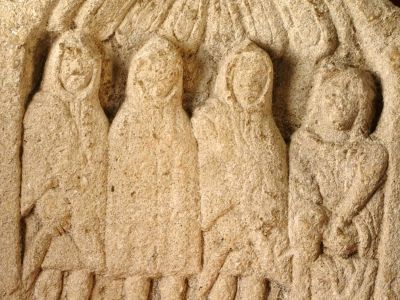
Read our latest blog post about the Septimius Stone by Elliot Masefield from The Cotswold School. The Septimius stone is a stone block that once stood at the base of a restored Jupiter column. The inscription carved into its face commemorates the governor Lucius Septimius, by whom the monument was restored.
Genii Cuculatti peoem and blog post by Corinium Museum's poet in residence Juliette Morton.
Corinium Museum has appointed Emma Stuart as its new Museum Director.
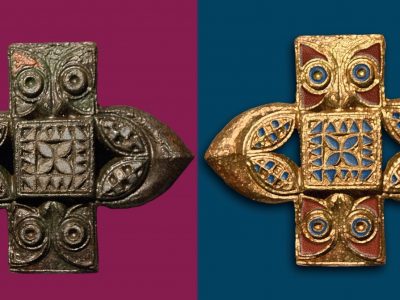
Gazing at the beautiful red garnets glinting in gold at the Corinium Museum’s Anglo-Saxon exhibit, I could imagine the lustre of the dragon’s hoard in ‘Beowulf’, brought to life through archaeology. My love of early medieval artefacts and literature grew through studying Fine Art, English Literature and Medieval History A-Levels, yet this exhibit has inspired me to consider Old English literature with a new light on archaeology, landscape and material culture.
Blog post by recent A-Level work placement Henry Boulton.