Some 200 years ago, an act was passed in Parliament: “an act for paving, cleansing, draining lighting, watching, regulating and improving the Town of Cirencester”. So far, so yawn inducing, you might think. However, the outcomes of this act had enormous consequences for the town. The act went on – “the Footpaths … within the […]
11th November is Armistice Day, which was originally marked the end of the First World War, honouring those who died in the conflict. Remembrance Sunday is a chance to remember and honour the service and sacrifice those from Britain and the Commonwealth who fought in the First and Second World War and other conflicts. As […]
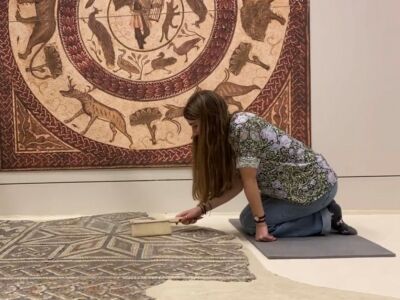
My name is Amber Swanson, and I’m a conservation student from the United States, currently gaining experience in the UK at the Withington Villa excavations while preparing for graduate study. I’ve known the archaeologists from the Withington Villa excavation for some time, having worked with them on an excavation in Turkey, and it was through […]
In recent years, Greek and Roman mythology have gained renewed popularity among the public, with modern retellings of their myths appearing in various formats. From books to musicals to films, these contemporary adaptations take classic stories and characters, giving them a fresh style for us to enjoy. One such figure is the bard Orpheus, who […]
We know that Roman mosaics held religious connotations linked to paganism, as evidenced by many mosaics featuring their gods and mythology. The Barton Farm Orpheus mosaic, housed at the Corinium Museum, exemplifies this. However, some suggest that other religions, such as Christianity and native deities, have also influenced the depictions of Orpheus in these mosaics. […]
It’s been 200 years since the Orpheus mosaic, now on display in the Corinium Museum, was discovered at Barton Farm, Cirencester, in 1824/25. To mark this milestone, the museum has been participating in a National Lottery Heritage Fund partnership project with The Barn Theatre and New Brewery Arts to create Project Orpheus, aimed at raising […]
This year sees the 80th anniversary of the end of World War Two. September 2, 1945 is the date when all hostilities officially ended, after the war in Europe ended on May 8th and Japan unconditionally surrendered on August 14th. The Corinium Museum is hosting an exhibition and a Corinium Afternoons talk that explore life […]
Though deep-rooted, the abbey’s long dominance over Cirencester, since it was founded in 1117, could not last forever. In the 16th Century, the emergence of Protestantism was sweeping Europe, introducing the possibility of a church detached from papal authority. Protestant doctrine, which did not recognise purgatory, also undermined one of the key purposes of monasteries, […]
Archaeology is done in layers. Sequences of events can be discerned from the physical layers in the ground. These are known as archaeological contexts. They are generally discovered in reverse chronological order – the fill of a pit is discovered before the cut of the pit; building rubble is discovered before the floor, which in […]
It’s been a little while since the last update about the swords, when we shared about their conservation. A lot of work has been going on behind the scenes to get the swords into their display case. Fundraising by the Friends of Corinium Museum, along with some grant money from various sources, helped us to […]